Research

Discovery and synthesis pathways

exa-AMD searches composition-structure-property spaces, while exa-PD predicts thermodynamics and synthesis pathways.

Integrated research thrusts

Two complementary workflows for discovering materials and synthesis pathways

Thrust 1 | exa-AMD

AI/ML-assisted materials discovery and design

exa-AMD is a Python workflow framework that integrates materials databases, CGCNN and other ML models, MLIP relaxation, adaptive genetic algorithms, DFT validation, and convex-hull analysis through Parsl. The goal is rapid exploration of ternary, quaternary, and higher-order composition-structure spaces.

Overview workflow

The exa-AMD workflow starts from prototype structures and composition substitutions, uses machine learning to prioritize promising candidates, validates selected structures with first-principles calculations, and closes the loop with convex-hull and stability analysis.

  • Module I: scalable ML screening. Generate prototype-derived candidate structures, predict formation energies with CGCNN, select low-energy structures, and send candidates through DFT validation and convex-hull post-processing.
  • Module II: MLIP relaxation and hull sorting. Insert machine-learning interatomic-potential relaxation before DFT to accelerate local relaxation, candidate ranking, and preparation of high-value structures for first-principles calculations.
  • Module III: AGA + MLIP structure search. Use adaptive genetic algorithms with GPU-ready MLIP relaxation to predict new structure types from chemical composition alone, then feed promising results back into DFT and ML refinement.
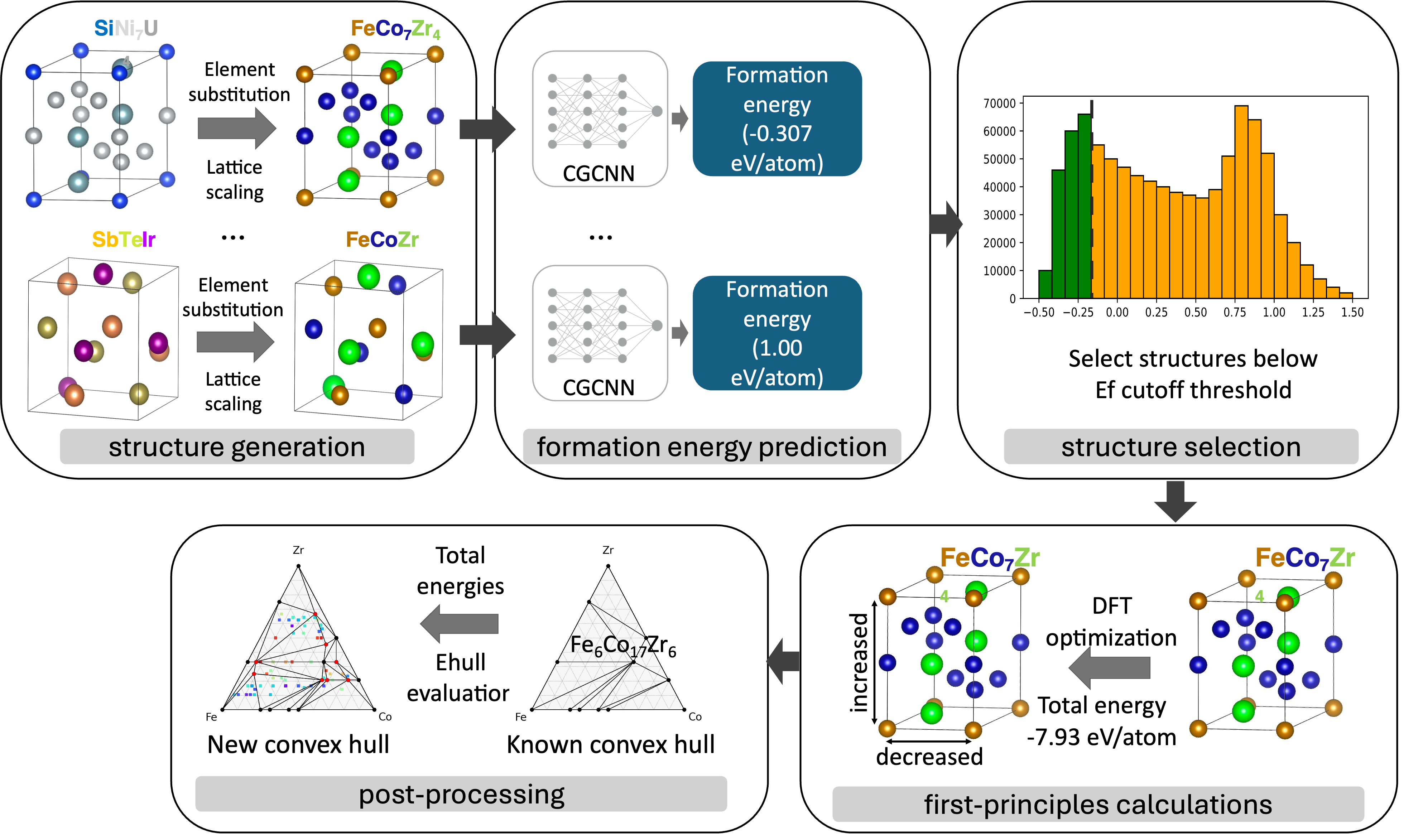
exa-AMD workflow for structure generation, formation-energy prediction, structure selection, first-principles calculations, and post-processing
exa-AMD overview workflow connecting structure generation, ML screening, DFT validation, and post-processing.

Research progress

The framework is ready for applications to search for ternary compounds. The speedup of the framework scales almost linearly with the number of GPUs. For any ternary system with three chemical elements, it produces a map of comprehensive composition-structure-energy landscape in just a few hours. About 1000 candidate structures were selected from CGCNN for first-principles calculations. Using 32 GPUs on Perlmutter at NERSC, the energy calculations completed in about 3-4 hours. For most ternary systems, about 2000 candidate structures per system will be selected for DFT calculations, which can complete within a few hours using 64 GPUs. The framework can also perform searches for many ternary systems simultaneously, scaling to several thousand GPUs when sufficient resources are available.
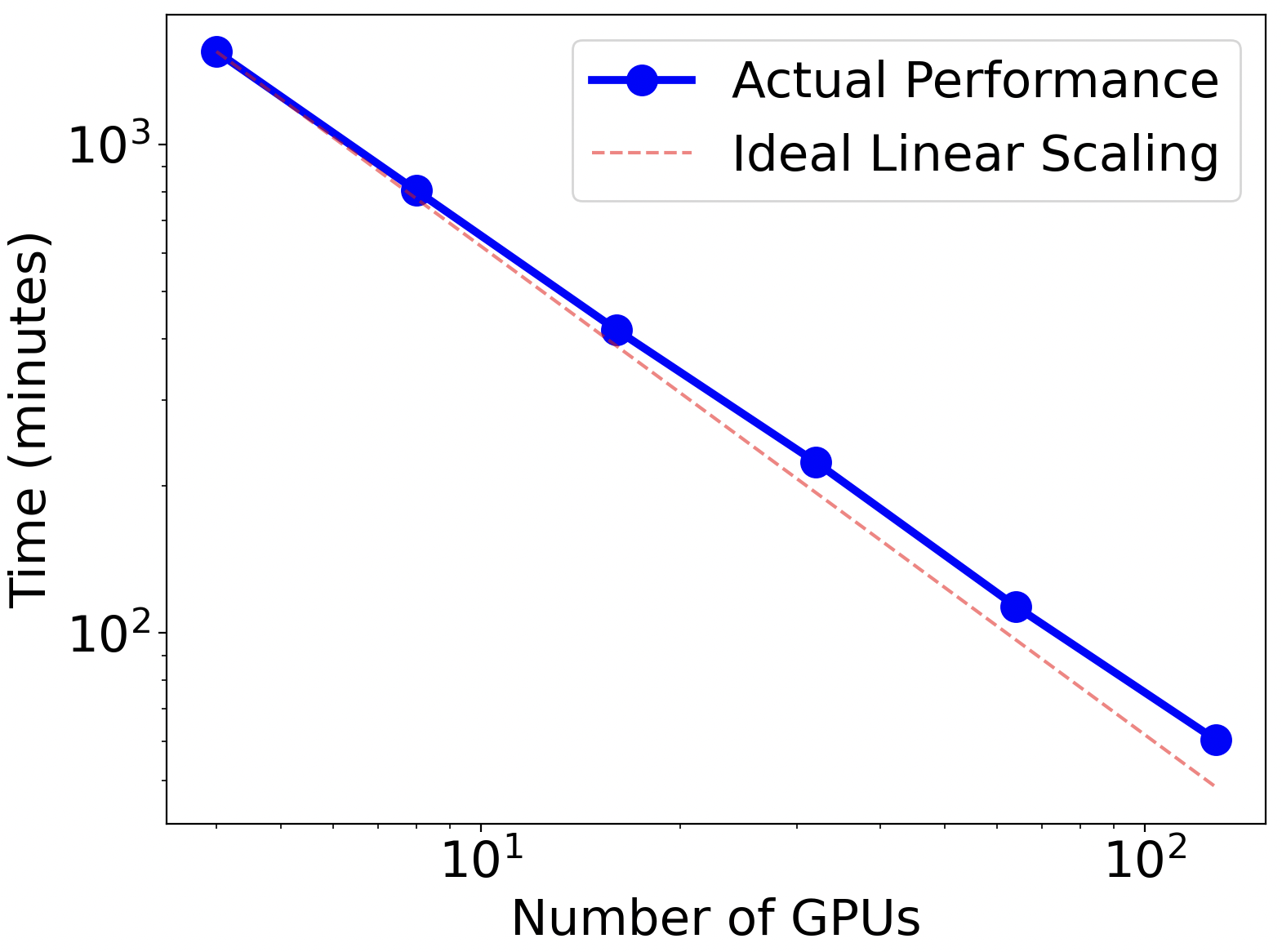
exa-AMD scaling plot showing near-linear performance as GPUs increase
GPU scaling performance for exa-AMD workflow execution on leadership-class resources.
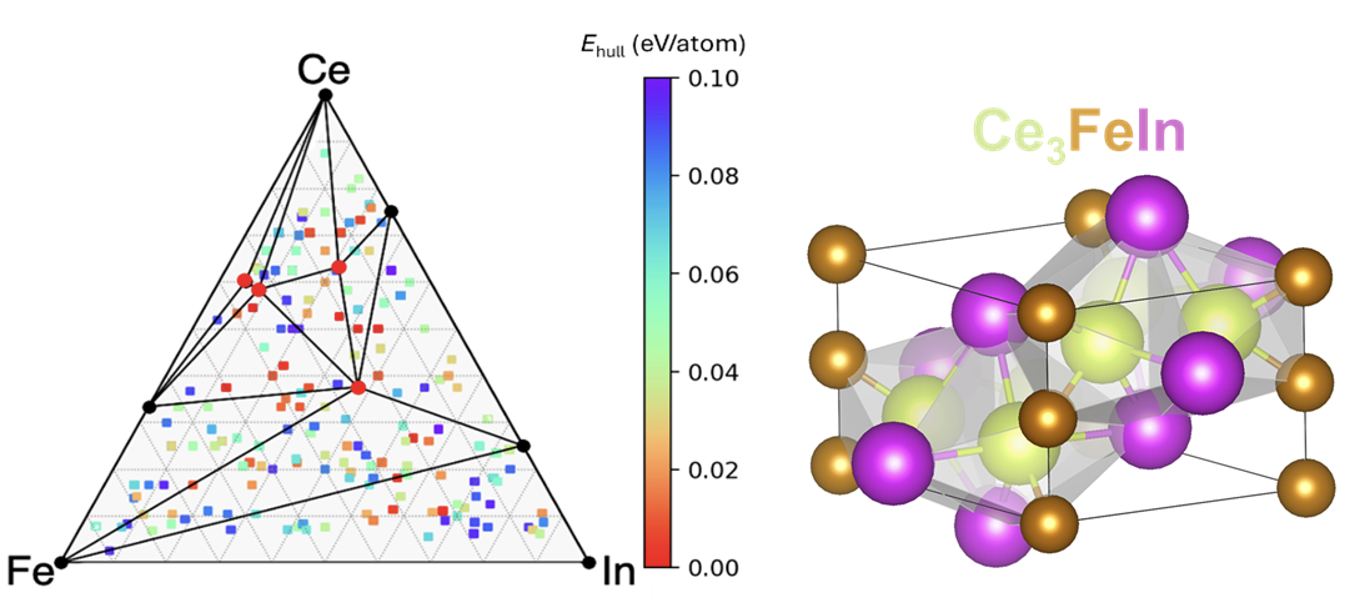
exa-AMD predicted convex hull and Ce-Fe-In crystal structure output
Current exa-AMD progress example: predicted convex hull and candidate structure from a Ce-Fe-In search.

Paper and code

The exa-AMD workflow has been released as open-source software and documented in a citable software paper. The public release provides workflow modules for structure generation, ML screening, first-principles validation, and post-processing.

Thrust 2 | exa-PD

Exascale phase diagrams and synthesis-pathway prediction

exa-PD develops a massively parallel workflow for multi-element phase-diagram construction and synthesis-pathway insight. Parsl coordinates hundreds of dependent molecular-dynamics jobs, neural network potentials extend length and time scales, and thermodynamic integration plus CALPHAD analysis convert simulation output into reusable phase-diagram data.

Overview workflow

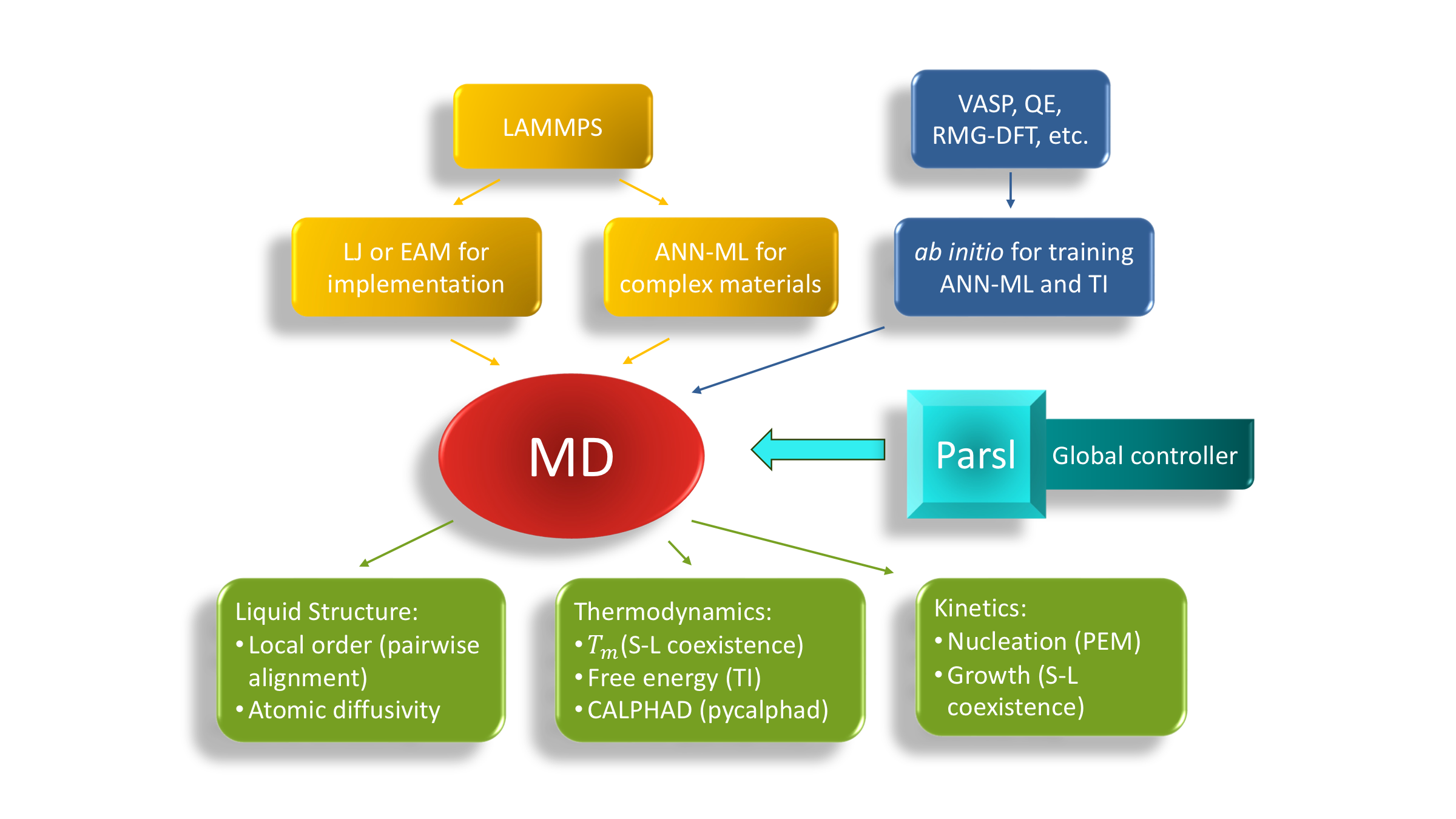
Thrust 2 connects LAMMPS molecular dynamics, empirical or machine-learning interatomic potentials, ab initio training calculations, thermodynamic integration, CALPHAD modeling, liquid-structure descriptors, and kinetic modeling under Parsl workflow control.

  • Module I: exa-PD phase diagrams. Run large ensembles of MD jobs with Parsl, use thermodynamic integration for accurate free energies, and convert the results into CALPHAD-compatible phase-diagram data.
  • Module II: nucleation and growth kinetics. Apply persistent-embryo and solid-liquid coexistence simulations to estimate nucleation rates, phase-selection tendencies, and orientation-dependent growth behavior.
  • Module III: liquid structure and dynamics. Analyze local order, cluster similarity, clique motifs, and atomic mobility in liquids to connect finite-temperature structure to synthesizability and pathway selection.
Thrust 2 workflow connecting LAMMPS, molecular dynamics, ab initio training, Parsl, thermodynamics, liquid structure, and kinetics
Thrust 2 workflow for exascale thermodynamics, phase diagrams, and synthesis-pathway prediction.

Research progress

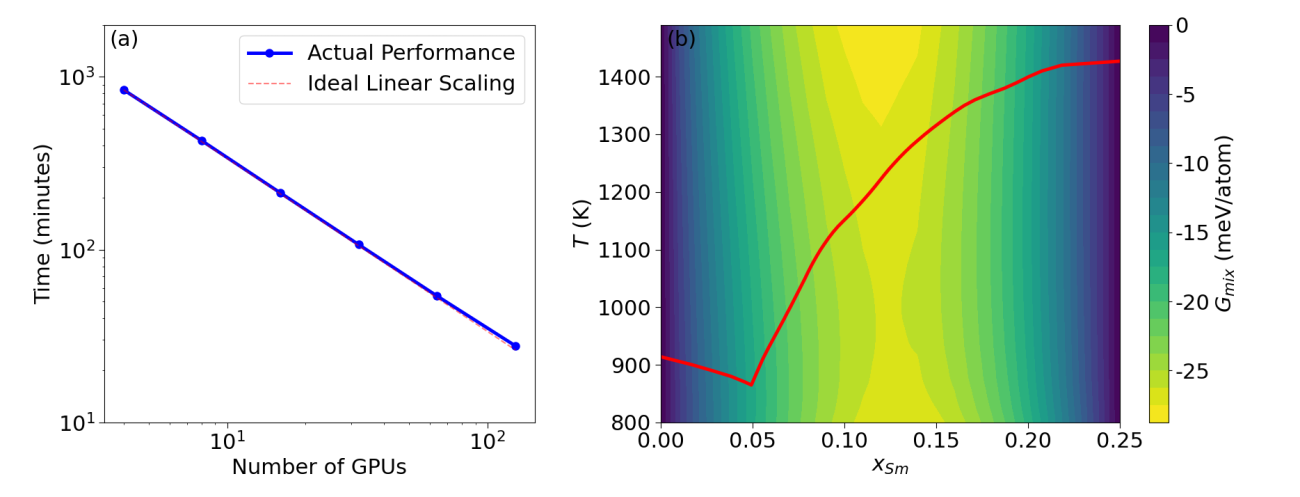
The phase diagram based on precise free energy calculations provides essential guidance for materials synthesis. The thermodynamic integration technique is highly accurate for free energy calculations, yet it is also resource-demanding. For instance, hundreds of MD jobs are required to map out the free energy of a binary solution phase as a function of temperature and composition. The team has set up a framework that uses Parsl, an open-source Python library for parallel programming, to efficiently manage MD jobs according to the available resources. Demonstrations for Al-Sm liquid show nearly ideal strong scaling for free-energy calculations and provide mixing Gibbs free energy data that can be used in CALPHAD modeling to obtain phase-boundary information.

Thrust 2 research progress figure showing GPU scaling and Al-Sm liquid free-energy calculations
Temporary Thrust 2 progress figure from the Ames Lab research page; this will be replaced once a high-resolution version is available.

Paper and code

The exa-PD workflow is available as open-source code and described in a public preprint. The release supports massively parallel molecular-dynamics based free-energy calculations and CALPHAD-compatible phase-diagram construction.